
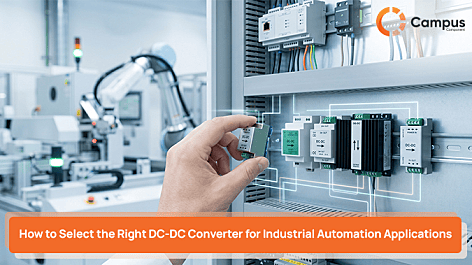
 What Is a DC-DC Converter and Its Role in Industrial Systems
ADC-DC converter is a power conversion device that adjusts one DC voltage level to another, ensuring that different components within a system receive the voltage they need to operate properly. In industrial automation, where multiple devices operate on different voltage levels, it ensures smooth and regulated power distribution. It helps improve system reliability and prevents unexpected failures in automation setups by handling voltage variations and power inconsistencies. These converters are widely used in advanced industrial systems to:
Power PLCs and control units
Supply sensors and IoT modules
Support industrial communication systems
Stabilize distributed power architectures
In simple terms, DC-DC converters make sure every device in the automation system gets the right voltage consistently, even when the input power fluctuates. This helps equipment operate smoothly and reduces the risk of performance issues or unexpected downtime.
What to Look for When Choosing a DC-DC Converter
Selecting the right converter is not just about voltage matching. Several system-level factors must be considered:
Input Voltage Requirements
Industrial systems often experience fluctuating inputs from batteries, SMPS units, or distributed grids. A wide input voltage DC-DC converter ensures stable operation even under variation.
Output Voltage Stability
Automation systems require precise voltage levels to avoid control errors. Even minor instability can affect PLC logic or sensor readings.
Efficiency Considerations
The higher efficiency of DC-DC converters reduces heat generation and improves system reliability, especially in enclosed control panels.
Power Rating and Load Requirements
The converter should be able to manage peak power loads safely without breaking down. If it is too small, it can heat up and become unstable. If it is too large, it increases system cost unnecessarily.
Isolated vs Non-Isolated DC-DC Converters
One of the most important selection decisions in industrial power design is isolation. We will understand these differences between these converters with the help of the following set of questions:
What Is an Isolated DC-DC Converter?
An isolated DC-DC converter uses a transformer-based design to separate input and output electrically. There is no direct electrical connection between the two sides.
Benefits of Isolation in Industrial Systems
Protects sensitive circuits from high-voltage spikes
Reduces ground loop issues
Improves safety in high-voltage environments
Essential for PLCs and industrial communication systems
What Is a Non-Isolated DC-DC Converter?
A non-isolated converter is an electronic device that has a direct electrical connection and shares a common path for input and output. The device design is very simple, making it cost-effective. Unlike isolated converters, there are no physically different paths for the input and output sides.
This makes the design simpler, more compact, and cost-effective, which is why it is widely used in low-voltage and space-constrained industrial applications. It is commonly used in embedded systems where safety isolation is not a strict requirement.
When to Use Non-Isolated Solutions
Compact PCB-level power regulation
Low-voltage systems
Cost-sensitive embedded designs
Applications with shared grounding
Comparison: Isolated vs Non-Isolated DC-DC Converters
Feature | Isolated DC-DC | Non-Isolated DC-DC |
Safety | High | Moderate |
Cost | Higher | Lower |
Complexity | Higher | Lower |
Noise Immunity | Excellent | Limited |
Use Case | PLC, Industrial control | Embedded electronics |
Why Wide Input Voltage Support Matters
Industrial environments rarely provide stable voltage. Wide input support is important because:
Machines often run on fluctuating DC sources
Battery-powered systems discharge over time
Voltage spikes occur during switching operations
A wide input voltage DC-DC converter ensures uninterrupted operation even under unstable conditions, improving system uptime.
DC-DC Converters for DIN Rail and PLC Applications
Following are some key applications of DC-DC converters different file:
DIN Rail Mounting Benefits
DIN rail mounting simplifies installation inside control panels. It improves:
Space utilization
Maintenance efficiency
System organization
Powering PLC Systems
PLCs require highly stable voltage to maintain logic accuracy. DC-DC converters ensure consistent performance in automation lines.
Integration Best Practices
Maintain proper thermal spacing
Use correct grounding techniques
Avoid overloading shared power rails
Reliability Requirements in Harsh Industrial Environments
Industrial converters must perform consistently under extreme conditions:
Temperature Extremes
Devices must operate across wide temperature ranges without performance loss.
Vibration and Shock Resistance
Factories and machinery generate continuous mechanical stress.
Industrial Certifications
Compliance with IEC, UL, and ISO standards ensures reliability and safety in mission-critical systems.
Common Mistakes to Avoid
Many system failures occur due to poor selection decisions:
Ignoring load surge requirements
Choosing incorrect isolation type
Undersizing power ratings
Overlooking thermal design
Skipping EMI/EMC considerations
Avoiding these mistakes improves long-term system reliability
DC-DC Converter Selection Checklist
Use this quick decision framework:
Identify input voltage range
Define output voltage stability requirement
Decide isolation vs non-isolation
Check total load capacity + surge margin
Evaluate thermal conditions
Confirm industrial certifications
Consider mounting type (PCB/DIN rail)
Future Trends in Industrial Power Solutions
Industrial power systems are evolving rapidly:
Smart energy monitoring in converters
Integration with Industry 4.0 systems
AI-based predictive power management
Higher efficiency compact modules for edge devices
These advancements are making industrial DC-DC converters more intelligent and adaptive.
Final Thoughts
Selecting the right DC-DC converter for industrial automation is an advanced design decision that impacts system reliability, safety, and performance. From isolation requirements to input voltage stability and environmental durability, every factor plays a role in long-term success.
At Campus Component, we support engineers and OEMs with reliable industrial-grade DC-DC converter solutions designed for PLC systems, DIN rail installations, and harsh industrial environments.
A well-chosen power architecture ensures not just stable operation, but also scalable and future-ready automation systems.
Need help selecting the right DC-DC converter for your industrial automation system? Contact our engineering team for expert guidance and customized recommendations. Explore our range of industrial-grade DC-DC converters designed for PLCs, DIN rail installations, and harsh industrial environments.
FAQs:
1. What is the difference between isolated and non-isolated DC-DC converters?
Isolated converters separate input and output electrically, improving safety and noise immunity. Non-isolated converters share a common ground and are simpler.
2. When should I use an isolated DC-DC converter?
Use isolation in PLCs, industrial networks, and high-voltage environments where safety and noise protection are critical.
3. Why is wide input voltage important?
It ensures stable operation even when industrial power sources fluctuate or degrade over time.
4. Can DC-DC converters be used with DIN rail systems?
Yes, many industrial DC-DC converters are designed for DIN rail mounting inside control panels.
5. What power supply is best for PLC systems?
A stable, isolated industrial DC-DC converter with low noise and high reliability is recommended.
6. How do industrial converters handle harsh environments?
They are designed with rugged components, thermal protection, and compliance with industrial safety standards.
7. What certifications should they have?
IEC, UL, CE, and ISO certifications are commonly required for industrial deployment.
8. How do I calculate the required power rating?
Add total load consumption and include at least 20–30% safety margin for peak conditions.