
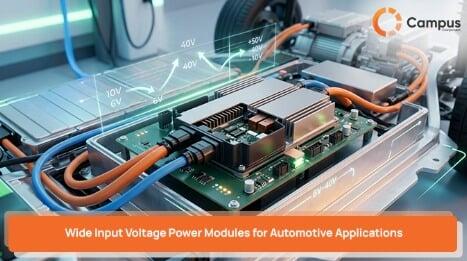
What Are Wide Input Voltage Power Modules?
A wide input voltage power module is a power conversion solution designed to operate efficiently across a broad range of input voltages while providing a stable output voltage for electronic systems.
In automotive applications, these modules typically function as DC-DC converters, converting fluctuating battery voltage into regulated power required by different vehicle components.
For example, an EV battery pack may operate at high voltage levels, while individual electronic systems may require lower and more stable voltages. A wide voltage input converter ensures that these systems receive the correct power without being affected by battery variations. A standard automotive power module includes:
Power switching components
Control circuits
Voltage regulation systems
Protection mechanisms
Thermal management features
Unlike standard power modules designed for fixed voltage conditions, wide input voltage power modules provide greater flexibility and reliability in demanding automotive environments.
Why Automotive Electronics Need Wide Input Voltage Support
Automotive systems experience several operating conditions where voltage stability becomes challenging. A reliable power module must be capable of handling these variations without affecting system performance.
Battery Voltage Fluctuations
Vehicle batteries do not always provide a constant voltage output. Changes in battery charge level, electrical load, and operating conditions can create voltage variations.
Wide input voltage power modules compensate for these changes and maintain stable output power for critical electronics.
Cold Crank Conditions
During vehicle startup, especially in low-temperature environments, battery voltage can temporarily drop. This condition is known as a cold crank event.
Automotive power modules must continue supplying power to essential systems even during these short voltage drops.
Load Dump Events
A load dump occurs when a vehicle’s electrical load suddenly changes, creating a temporary voltage spike. Without proper protection, these spikes can damage sensitive electronics.
Automotive-grade power modules include protection features to handle such events safely.
Support for 12V, 24V, and 48V Architectures
Modern vehicles use different electrical architectures depending on their application, such as:
12V systems are common in passenger vehicles
24V systems are widely used in commercial vehicles
48V systems support hybrid vehicles and advanced electrical systems
Wide input voltage modules provide flexibility across multiple vehicle platforms.
Key Features of Automotive Power Modules
Choosing an automotive power module requires evaluating several performance factors beyond basic voltage conversion.
Wide Input Voltage Range
The ability to support different input conditions allows vehicles to operate reliably under changing electrical environments.
High Efficiency
Efficient DC-DC conversion reduces energy loss and heat generation, which is especially important for EV applications where energy management directly impacts driving range.
Compact Design
Modern vehicles have limited space for electronic components. Compact power modules allow easier integration into control units and electronic assemblies.
Thermal Management
Automotive environments experience extreme temperature variations. Effective thermal design ensures stable performance during both high-temperature and cold-weather operation.
Protection Features
Reliable automotive power modules typically include:
Over-voltage protection
Under-voltage lockout
Short-circuit protection
Over-temperature protection
These features improve system safety and extend component lifespan.
EMI Compliance
Electromagnetic interference can affect communication systems and sensors. Automotive power modules must minimize electrical noise to maintain signal integrity.
Applications of Wide Input Voltage Power Modules in Modern Vehicles
The growing complexity of vehicles has increased the demand for efficient power management solutions.
Electric Vehicles (EVs)
EVs depend heavily on power electronics for battery management, charging systems, motor control, and auxiliary electronics.
Wide input voltage power modules help regulate power distribution between different vehicle subsystems.
Advanced Driver Assistance Systems (ADAS)
ADAS technologies such as cameras, radar sensors, and LiDAR require uninterrupted power because any failure can impact vehicle safety functions. A stable power conversion ensures reliable operation of these systems.
Infotainment and Digital Dashboards
Modern vehicles feature high-performance displays, navigation systems, and connected services that require consistent power delivery.
Telematics Systems
Connected vehicles rely on telematics units for remote monitoring, diagnostics, and communication. Automotive DC-DC converters help maintain reliable operation of these systems.
Lighting and Body Control Modules
Electronic lighting systems and body control units require regulated power to operate efficiently.
Wide Input Voltage Power Modules vs Standard Power Modules
Feature | Wide Input Voltage Power Modules | Standard Power Modules |
Voltage Range | Supports wider voltage variations | Designed for limited voltage ranges |
Automotive Suitability | Suitable for EVs and vehicle electronics | Limited automotive applications |
Reliability | Handles harsh operating conditions | Lower tolerance to fluctuations |
Protection Features | Advanced protection mechanisms | Basic protection |
Applications | EVs, ADAS, telematics, industrial vehicles | General electronics |
For automotive applications, wide input voltage power modules provide better reliability and long-term performance despite higher design requirements.
Important Selection Criteria for Automotive Power Modules
Selecting the right automotive DC-DC converter requires evaluating both electrical and environmental factors. Key considerations include:
Input Voltage Range
Ensure the module can handle the vehicle’s minimum and maximum voltage conditions.
Output Requirements
Check whether the output voltage and current match the requirements of connected electronics.
Efficiency
Higher efficiency reduces energy loss and improves thermal performance.
Isolation Requirements
Some applications require isolated power modules for electrical safety and noise reduction.
Operating Temperature
Automotive components must perform reliably under extreme temperature conditions.
EMC Performance
The module should meet electromagnetic compatibility requirements to avoid interference with vehicle systems.
Certifications
Automotive applications often require compliance with standards such as AEC-Q100 and ISO 26262.
Campus Component supports engineers and designers in selecting suitable power conversion solutions based on application requirements, voltage specifications, and system design needs.
Automotive Standards and Certifications
Automotive electronics must meet strict reliability and safety requirements. Some of the standards and certifications automotive manufacturers should take a note of include:
AEC-Q100
AEC-Q100 is an automotive qualification standard used to evaluate the reliability of integrated circuits under conditions such as temperature stress, mechanical stress, and electrical performance.
ISO 26262
ISO 26262 focuses on functional safety in automotive systems. It provides guidelines for reducing risks associated with electronic system failures.
CISPR 25
CISPR 25 defines electromagnetic emission requirements for vehicle components to ensure electronic systems operate without interference. Compliance with these standards helps manufacturers develop safer and more reliable vehicles.
Common Design Challenges in Automotive Power Systems
Despite advances in power electronics, engineers still face several design challenges, such as:
Heat Dissipation
High power density can generate heat, requiring effective thermal management strategies.
Noise Reduction
Poor power design can create electrical noise that affects communication and sensor systems.
PCB Layout
Proper component placement and grounding techniques are essential for maintaining efficiency and reducing interference.
Reliability
Automotive systems are expected to operate for years under demanding conditions, making component selection .
Future Trends in Automotive Power Modules
Automotive power management continues to evolve with emerging technologies.
800V EV Platforms
Higher voltage EV architectures enable faster charging and improved efficiency, increasing demand for advanced power conversion solutions.
Smart Power Management
Future vehicles will use intelligent power systems capable of monitoring and optimizing energy usage.
AI-Based Diagnostics
AI-powered systems will help predict failures and improve vehicle maintenance strategies.
GaN and SiC Technologies
Wide-bandgap semiconductors such as Gallium Nitride (GaN) and Silicon Carbide (SiC) enable higher efficiency and better thermal performance.
The Bottom Line
With the increasing demand for connected, electrified, and intelligent, reliable power management has become an essential part of automotive design. Wide input voltage power modules provide the flexibility and stability required to support modern vehicle electronics operating under constantly changing conditions.
From EV platforms and ADAS systems to telematics and smart mobility solutions, automotive DC-DC converters help ensure efficient and dependable power delivery.
Choosing the right automotive power module requires careful evaluation of voltage range, efficiency, safety standards, thermal performance, and application requirements. Having expertise in power conversion solutions, Campus Component helps engineers and businesses identify suitable components for next-generation automotive applications.
Need assistance selecting the right wide input voltage power module for your automotive project? Connect with Campus Component’s engineering team to explore reliable DC-DC converter solutions designed for EVs, smart vehicles, and advanced automotive electronics.
FAQs:
1. What is a wide input voltage power module?
A wide input voltage power module is a DC-DC converter designed to operate across a broad range of input voltages while providing stable output power for electronic systems.
2. Why do automotive applications require wide input voltage support?
Vehicles experience voltage changes due to battery conditions, startup events, and electrical loads. Wide input voltage modules help maintain reliable power delivery during these variations.
3. How does a DC-DC power module work in a vehicle?
A DC-DC power module converts battery voltage into regulated voltage levels required by different vehicle systems such as sensors, controllers, and infotainment units.
4. Which power modules are suitable for electric vehicles?
Automotive-grade DC-DC converters with high efficiency, thermal reliability, protection features, and wide voltage support are commonly used in EV applications.
5. What is the difference between isolated and non-isolated automotive power modules?
Isolated modules provide electrical separation between input and output circuits, improving safety and reducing noise. Non-isolated modules offer simpler designs and higher efficiency for applications where isolation is not required.
6. Why are automotive-grade power modules more reliable?
Automotive-grade modules are designed to withstand temperature variations, electrical stress, vibration, and long operating cycles required in vehicle environments.
7. What certifications should automotive power modules have?
Common automotive requirements include AEC-Q100 qualification, ISO 26262 functional safety considerations, and EMC compliance standards.
8. How do wide input voltage modules support EV systems?
They regulate power between different EV subsystems, ensuring stable operation of battery management systems, controllers, sensors, and other electronic components.