
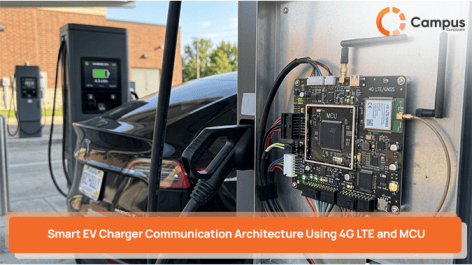
 Understanding Smart EV Charger Architecture
A smart EV charger, also called as Electric Vehicle Supply Equipment (EVSE), is an intelligent system that acts as a secure communication bridge between the electric grid, the charging network, and the vehicle. These smart charging systems utilize advanced hardware and software to optimize charging times, manage energy consumption, and process payment.
Core layers include:
Hardware Layer: MCU, power modules, sensors, and LTE module
Communication Layer: LTE, OCPP, MQTT, HTTP protocols
Application Layer: Cloud backend, mobile apps, dashboards
Control Layer: Charging logic, safety systems, load management
This layered structure ensures that EV chargers can operate independently while staying connected to cloud platforms for monitoring and control.
Hardware Layer: MCU, power modules, sensors, and LTE module
Communication Layer: LTE, OCPP, MQTT, HTTP protocols
Application Layer: Cloud backend, mobile apps, dashboards
Control Layer: Charging logic, safety systems, load management
Role of MCU in Smart EV Chargers
Microcontroller units (MCUs) serve as the brain of smart EV chargers which are responsible for controlling power conversion, safety monitoring, communication, and user interaction. They are essential for managing the complex interaction between the electric grid and the EV battery, ensuring safe and efficient energy transfer.
Key functions of MCU include:
Controls charging cycles and power flow
Helps monitoring voltage, current, and temperature in real time
Handles communication with LTE module and backend systems
Executes safety checks and fault protection
Supports firmware updates and system logic execution
Why MCU is essential:
MCUs ensure real-time decision-making, which is essential for safe EV charging operations.
Common MCU families used:
ARM Cortex-M series
STM32 microcontrollers
NXP automotive MCUs
Renesas embedded controllers
These MCUs are widely used in embedded EV charger firmware architecture for their reliability and low power consumption.
Controls charging cycles and power flow
Helps monitoring voltage, current, and temperature in real time
Handles communication with LTE module and backend systems
Executes safety checks and fault protection
Supports firmware updates and system logic execution
ARM Cortex-M series
STM32 microcontrollers
NXP automotive MCUs
Renesas embedded controllers
Why 4G LTE is Used in EV Charging Systems
4G LTE is primarily used in EV charging systems to ensure reliable, high-speed connectivity for remote monitoring, real-time payment processing, and secure over-the-air software updates. It offers superior reliability compared to Wi-Fi. Key reasons why 4G LTE is used include:
Reliable Connectivity: 4G networks help charging stations stay connected and operational, even in public or remote locations where Wi-Fi coverage may be inconsistent.
Real-Time Monitoring: Operators can track station usage, energy consumption, and overall performance instantly, making day-to-day management much easier.
Remote Maintenance & Better Security: With 4G connectivity, many charger issues can be identified and resolved remotely, which helps reduce unnecessary on-site maintenance visits. It also supports secure and encrypted communication to help protect against cyber threats.
Faster and Easier Installation: Cellular connectivity, especially with eSIM technology, removes the need for complex cabling, helping charging stations get installed more quickly and cost-effectively.
Smarter Charging Experience: 4G supports features like real-time payment processing, user authentication, and smart load management for a smoother and more efficient charging experience.
Reliable Connectivity: 4G networks help charging stations stay connected and operational, even in public or remote locations where Wi-Fi coverage may be inconsistent.
Real-Time Monitoring: Operators can track station usage, energy consumption, and overall performance instantly, making day-to-day management much easier.
Remote Maintenance & Better Security: With 4G connectivity, many charger issues can be identified and resolved remotely, which helps reduce unnecessary on-site maintenance visits. It also supports secure and encrypted communication to help protect against cyber threats.
Faster and Easier Installation: Cellular connectivity, especially with eSIM technology, removes the need for complex cabling, helping charging stations get installed more quickly and cost-effectively.
Smarter Charging Experience: 4G supports features like real-time payment processing, user authentication, and smart load management for a smoother and more efficient charging experience.
Communication Flow Between EV Charger, Cloud, and User Applications
In 2026, EV chargers, cloud platforms, and mobile apps work together through a real-time communication system using OCPP 2.0.1 over WebSockets. This setup enables secure, seamless connectivity and ensures different charging hardware and software platforms can work together smoothly.
1. Charger-to-Cloud Communication
EV chargers connect to the internet through Ethernet, Wi-Fi, or cellular networks and communicate with the backend system using OCPP. While OCPP 1.6J is still common, the industry is rapidly moving toward OCPP 2.0.1 and 2.1 for stronger security and smarter charging features. Chargers continuously share data like charging status, energy usage, and authentication requests, while the backend can remotely control charging sessions, unlock connectors, or push firmware updates securely.
2. Backend System Operations
The backend platform acts as the central control system for the entire charging network. It manages charging sessions, balances energy loads, processes payments, verifies users, and supports roaming between different charging operators. It also connects with smart grids to optimize charging during peak electricity demand.
3. Mobile App Connectivity
The mobile app communicates with the backend through APIs, allowing users to start or stop charging sessions remotely, track charging progress in real time, and view details like energy usage and remaining time. Modern EV charging systems now include secure authentication features like OAuth and Plug & Charge, making the charging experience simpler and more convenient for users.
Communication Protocols used in Smart EV Chargers
Smart EV chargers rely on multiple communication protocols:
OCPP (Open Charge Point Protocol): Standard protocol for EV charger-cloud communication
MQTT: Lightweight protocol for IoT telemetry data
HTTP/HTTPS: Used for APIs and backend communication
Modbus: Used in industrial energy systems
CAN Protocol: Used for internal vehicle and charger communication
OCPP is especially important as it ensures interoperability between different charging networks.
OCPP (Open Charge Point Protocol): Standard protocol for EV charger-cloud communication
MQTT: Lightweight protocol for IoT telemetry data
HTTP/HTTPS: Used for APIs and backend communication
Modbus: Used in industrial energy systems
CAN Protocol: Used for internal vehicle and charger communication
OCPP is especially important as it ensures interoperability between different charging networks.
LTE Module and MCU Integration Architecture
An LTE module connects to a microcontroller through a simple serial interface, where the MCU runs the device logic and the LTE module takes care of all cellular communication. This setup lets IoT and industrial devices get 4G connectivity for things like data transfer, remote control, and over-the-air updates.
Core Integration Architectures
Host-based architecture (MCU + external LTE modem): An MCU controls a separate LTE module using AT commands over UART/USB. Best for applications needing higher local processing like displays or camera-based systems.
Integrated SoC/module approach: MCU and LTE modem are combined into a single chip or module, ideal for compact, low-power devices like trackers and wearables.
Key advantage of integration: Simpler design, lower power use, reduced size, and fewer components overall.
MCU (host): Runs the main logic, reads sensors, and handles protocols like MQTT/HTTP (e.g., STM32, ESP32).
Hardware interface Components
LTE module (modem): Manages cellular connectivity and SIM communication (e.g., Quectel BG96, u-blox SARA-R410M).
Communication link: Usually UART, or USB/SPI for faster data exchange.
Power system: Needs strong power support due to high current spikes during transmission.
SIM setup: Uses either a physical SIM or eSIM for network access.
Software Architecture & Data Flow
MCU software layer: The MCU uses a driver or AT command manager to control the LTE module.
AT commands: Simple text commands are sent from the MCU to handle tasks like opening connections or sending data.
Built-in networking: The LTE module already manages TCP/IP, so the MCU only focuses on the actual data, not networking details.
Ready-made libraries: Vendor SDKs like Quectel or ST cellular stacks simplify integration with prebuilt APIs.
Host-based architecture (MCU + external LTE modem): An MCU controls a separate LTE module using AT commands over UART/USB. Best for applications needing higher local processing like displays or camera-based systems.
Integrated SoC/module approach: MCU and LTE modem are combined into a single chip or module, ideal for compact, low-power devices like trackers and wearables.
Key advantage of integration: Simpler design, lower power use, reduced size, and fewer components overall.
MCU (host): Runs the main logic, reads sensors, and handles protocols like MQTT/HTTP (e.g., STM32, ESP32).
LTE module (modem): Manages cellular connectivity and SIM communication (e.g., Quectel BG96, u-blox SARA-R410M).
Communication link: Usually UART, or USB/SPI for faster data exchange.
Power system: Needs strong power support due to high current spikes during transmission.
SIM setup: Uses either a physical SIM or eSIM for network access.
MCU software layer: The MCU uses a driver or AT command manager to control the LTE module.
AT commands: Simple text commands are sent from the MCU to handle tasks like opening connections or sending data.
Built-in networking: The LTE module already manages TCP/IP, so the MCU only focuses on the actual data, not networking details.
Ready-made libraries: Vendor SDKs like Quectel or ST cellular stacks simplify integration with prebuilt APIs.
Security Architecture in Connected EV Chargers
Security in connected EV chargers is built in layers to protect the power grid, user information, and the vehicles themselves. The architecture include:
Secure communication: Standards like ISO 15118 use digital certificates and encryption to ensure safe, verified communication between the vehicle and charger.
OCPP security: Newer OCPP versions (2.0.1/2.1) add stronger protections like encrypted messaging, secure boot, and safe firmware updates.
Access control: Different users and operators have defined permissions, ensuring only authorized actions are allowed through role-based access.
Physical security: Chargers are built with anti-tamper hardware since they are often installed in open public spaces.
Grid protection: Systems are designed to prevent unauthorized usage and protect the electrical grid from misuse or large-scale disruption.
Secure communication: Standards like ISO 15118 use digital certificates and encryption to ensure safe, verified communication between the vehicle and charger.
OCPP security: Newer OCPP versions (2.0.1/2.1) add stronger protections like encrypted messaging, secure boot, and safe firmware updates.
Access control: Different users and operators have defined permissions, ensuring only authorized actions are allowed through role-based access.
Physical security: Chargers are built with anti-tamper hardware since they are often installed in open public spaces.
Grid protection: Systems are designed to prevent unauthorized usage and protect the electrical grid from misuse or large-scale disruption.
Remote Monitoring and Diagnostics
Smart EV chargers support advanced remote monitoring features:
Real-time telemetry data collection
Fault detection and alerts
Predictive maintenance using usage patterns
Energy consumption tracking
Real-time telemetry data collection
Fault detection and alerts
Predictive maintenance using usage patterns
Energy consumption tracking
Challenges in Smart EV Charger Communication Systems
Despite various advancements of EV charger communication systems, several challenges also exist, which include:
Network latency in remote areas
Signal instability in dense urban environments
Cybersecurity risks in connected systems
Scalability issues for large deployments
Addressing these challenges requires strong embedded design and reliable LTE integration.
Network latency in remote areas
Signal instability in dense urban environments
Cybersecurity risks in connected systems
Scalability issues for large deployments
Future of Connected EV Charging Infrastructure
The future of EV charging communication is evolving rapidly with the following trends:
5G integration: For faster and ultra-low latency communication
AI-based charging management: For smart load balancing and prediction
Smart grid connectivity: For dynamic energy distribution
Vehicle-to-Grid (V2G): For two-way energy flow between EVs and grid
These technologies are expected to make EV charging more intelligent and energy-efficient.
The Bottom Line
A smart EV charger communication architecture built using MCU and 4G LTE enables reliable, scalable, and secure charging infrastructure. It connects hardware, cloud systems, and users in real time, ensuring better control, monitoring, and energy management. With the growing EV adoption, robust communication architecture is expected to become a key factor in building future-ready charging networks.
For companies developing EV infrastructure, investing in strong embedded systems and LTE-based connectivity is no longer optional, but essential.
Looking to develop scalable and secure smart EV charging systems? Connect with embedded and IoT engineering experts at Campus Component to build next-generation EV communication architectures.
FAQs:
1. What MCU is used in EV chargers?
Most EV chargers use ARM Cortex-M, STM32, NXP, or Renesas MCUs for real-time control and communication handling.
2. Why is 4G LTE used in EV charging stations?
4G LTE provides stable, wide-area connectivity, making it ideal for remote and public EV charging infrastructure.
3. What protocols are used in smart EV chargers?
Common protocols include OCPP, MQTT, HTTP/HTTPS, Modbus, and CAN for internal and external communication.
4. How does remote monitoring work in EV chargers?
EV chargers send real-time data to cloud servers via LTE, enabling monitoring, diagnostics, and control through dashboards or apps.
5. What is OCPP in EV charging?
OCPP (Open Charge Point Protocol) is a standard that allows EV chargers to communicate with backend management systems.
5G integration: For faster and ultra-low latency communication
AI-based charging management: For smart load balancing and prediction
Smart grid connectivity: For dynamic energy distribution
Vehicle-to-Grid (V2G): For two-way energy flow between EVs and grid