
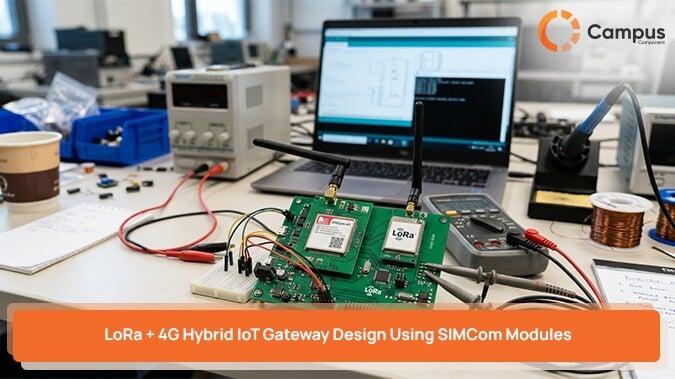
What Is a Hybrid IoT Gateway?
A hybrid IoT gateway acts as an intelligent bridge between field devices and cloud platforms. Instead of connecting every sensor directly to the internet, nearby sensors communicate with the gateway using LoRa, while the gateway itself uses a cellular network to forward data to cloud applications.
This architecture simplifies deployment, reduces communication costs, and allows thousands of sensors to operate efficiently over large areas.
A hybrid gateway consists of:
LoRa transceiver for sensor communication
MCU for local processing and device control
SIMCom 4G LTE module for internet connectivity
Power management circuitry
GNSS module (optional)
Cloud communication software
Local storage for offline operation
Rather than acting as a simple relay, modern gateways can filter data, perform edge analytics, manage connected devices, and continue operating even when network connectivity is temporarily unavailable.
Understanding LoRa and 4G Technologies
Although both LoRa and 4G enable wireless communication, they serve very different purposes. Understanding their individual strengths explains why they complement each other so well.
LoRa
LoRa (Long Range) is a Low Power Wide Area Network (LPWAN) technology designed for battery-powered IoT devices that transmit small amounts of data over long distances. Its major advantages include:
Communication over several kilometres in open environments
Extremely low power consumption
Long battery life for remote sensors
Low deployment costs
Excellent penetration through vegetation and buildings
These characteristics make LoRa ideal for environmental sensors, smart metering, agricultural monitoring, and industrial equipment.
4G LTE
Unlike LoRa, 4G LTE provides broadband cellular connectivity capable of transmitting larger amounts of information directly to cloud platforms. Its strengths include:
High-speed internet connectivity
Reliable nationwide network coverage
Secure cloud communication
Support for firmware updates
Remote device management
Real-time monitoring
SIMCom LTE modules support multiple network technologies, making them suitable for industrial deployments where reliable backhaul communication is essential.
Why Combine LoRa with 4G?
Each communication technology solves a different problem. LoRa efficiently gathers data from distributed sensors, while 4G ensures that collected information reaches cloud platforms without requiring wired internet infrastructure. Together, they create an architecture that delivers the best of both worlds.
Long-Range Sensor Connectivity
Hundreds of battery-powered sensors can communicate with a single gateway across large industrial sites without requiring individual SIM cards.
Reliable Internet Backhaul
Once sensor data reaches the gateway, the SIMCom LTE module securely forwards it to cloud dashboards using existing cellular networks, eliminating the need for fixed broadband connections.
Lower Deployment Costs
Instead of providing cellular connectivity to every field device, only the gateway requires a SIM card, significantly reducing communication costs.
Improved Power Efficiency
LoRa sensors consume very little energy and can operate for several years on a single battery, making them suitable for remote installations where frequent maintenance is impractical.
Continuous Remote Monitoring
Operators can monitor assets, receive alerts, and analyze performance data from virtually anywhere without visiting the installation site.
SIMCom Modules Suitable for Hybrid Gateway Design
Selecting the right communication module directly impacts gateway performance, scalability, and future upgrade options. SIMCom offers a broad portfolio of industrial-grade modules that support different deployment requirements. Some commonly used options include:
Module | Best For | Key Features |
SIM7600X Series | Industrial gateways | 4G LTE, CAT-4, GNSS, global band support, high-speed communication |
SIM7670X Series | Smart IoT deployments | LTE Cat 1, compact design, low power consumption |
SIM7070G Series | Battery-powered gateways | LTE Cat M1, NB-IoT support, energy-efficient communication |
SIM8200X Series | Advanced industrial applications | 5G readiness, ultra-low latency, high bandwidth |
Typical Hardware Architecture
Designing a reliable hybrid gateway requires careful integration of several hardware components. Each element plays a specific role in ensuring dependable communication between field devices and cloud platforms. A standard gateway architecture includes:
Microcontroller (MCU): Manages local processing, sensor communication, and system control.
LoRa Transceiver: Receives and transmits data from nearby LoRa-enabled sensors.
SIMCom Cellular Module: Establishes secure LTE connectivity for cloud communication.
Power Management Circuit: Ensures stable operation while protecting the system from voltage fluctuations.
GNSS Receiver: Provides accurate location data for mobile or asset-tracking applications.
External Antennas: Optimise LoRa and LTE signal strength, particularly in challenging environments.
A well-designed hardware architecture not only improves communication reliability but also simplifies maintenance and future scalability.
Software Architecture of a Hybrid IoT Gateway
While hardware provides the foundation, software architecture determines how efficiently the gateway processes, manages, and transfers data. A well-designed firmware framework allows gateways to handle multiple devices, maintain secure communication, and support future upgrades. The software architecture generally includes multiple layers:
Device Communication Layer
This layer manages communication between LoRa sensor nodes and the gateway. It handles data collection, device identification, packet management, and error handling.
For example, in a smart agriculture system, multiple soil moisture sensors transmit data through LoRa, which the gateway collects and prepares for cloud transmission.
Network Communication Layer
The network layer manages communication between the gateway and cloud platforms through the SIMCom cellular module.
Common communication protocols include:
MQTT for lightweight IoT messaging
HTTP/HTTPS for web-based communication
TCP/IP for reliable data transmission
MQTT is particularly popular in IoT applications because it requires low bandwidth and supports efficient communication between thousands of connected devices.
Cloud Integration Layer
The cloud integration layer allows businesses to remotely monitor devices, analyse data, and manage connected assets.
Through cloud platforms, users can access:
Real-time dashboards
Device health monitoring
Historical data analysis
Alert notifications
Remote configuration
This capability transforms a simple gateway into an intelligent IoT management system.
OTA Firmware Updates
Modern IoT deployments often involve thousands of devices installed across different locations. Manually updating every gateway is expensive and time-consuming.
OTA (Over-the-Air) updates allow manufacturers to remotely:
Deploy new firmware versions
Fix software issues
Improve security
Add new features
This capability significantly improves product lifecycle management.
Communication Workflow
Understanding the data flow helps explain why hybrid gateways are becoming increasingly popular across industrial applications. The standard communication process works as follows:
Step 1: Data Collection from Sensors
IoT sensors installed in the field collect information such as temperature, humidity, machine status, energy consumption, or location data.
Step 2: LoRa-Based Transmission
The collected data is transmitted wirelessly to the nearby gateway using LoRa communication. Since LoRa supports long-range connectivity, sensors can operate even in geographically distributed areas.
Step 3: Local Processing at Gateway
The gateway receives the sensor data and performs initial processing. It may filter unnecessary information, combine multiple data packets, or identify abnormal conditions before sending data to the cloud.
Step 4: 4G Connectivity Through SIMCom Module
The SIMCom cellular module transfers processed information to cloud servers using secure cellular communication.
This eliminates dependency on local internet infrastructure and allows deployment in remote locations.
Step 5: Cloud Analytics and Dashboard Access
Industrial Applications of LoRa + 4G Hybrid IoT Gateways
The flexibility of hybrid connectivity makes it suitable for industries where reliable communication, remote monitoring, and operational efficiency are critical.
Smart Agriculture
Agricultural operations often cover large geographical areas where traditional connectivity options are limited. Hybrid gateways allow farmers to collect data from soil sensors, weather stations, and irrigation systems while transmitting information to cloud platforms through cellular networks. This enables:
Automated irrigation management
Crop condition monitoring
Reduced water consumption
Data-driven farming decisions
Smart Metering
Utility companies use hybrid gateways for collecting data from electricity, gas, and water meters installed across residential and industrial locations. The architecture helps utilities achieve:
Remote meter reading
Reduced manual inspections
Better energy management
Faster fault identification
Industrial Asset Monitoring
Manufacturing plants and industrial facilities require continuous monitoring of equipment performance. LoRa sensors can collect machine data, while the 4G gateway transfers information to monitoring platforms for:
Predictive maintenance
Equipment health tracking
Production optimization
Environmental Monitoring
Government agencies and industries use IoT gateways to monitor air quality, temperature, water conditions, and environmental parameters in remote areas. Hybrid connectivity ensures that critical environmental data reaches monitoring systems even where wired infrastructure is unavailable.
Advantages of SIMCom Modules for Hybrid IoT Gateway Development
Selecting the right communication module is one of the most important decisions in IoT gateway development because connectivity directly impacts system reliability, scalability, and long-term performance. A gateway deployed in industrial or remote environments must maintain stable communication despite changing network conditions and operational challenges.
SIMCom modules provide developers with flexible cellular connectivity options that simplify the design of hybrid IoT gateways. Their wide range of LTE and IoT communication modules helps businesses build solutions for different application requirements, from low-power monitoring devices to high-performance industrial gateways.
Reliable Cellular Connectivity
One of the biggest advantages of SIMCom modules is their ability to provide consistent cellular communication across different deployment environments. This makes them suitable for remote monitoring applications where wired internet connectivity may not be practical.
For industries such as agriculture, utilities, and infrastructure monitoring, reliable cellular connectivity ensures that critical field data reaches cloud platforms without interruption.
Global Network Compatibility
IoT products are often deployed across different regions with varying network requirements. SIMCom modules support multiple cellular technologies and frequency bands, helping manufacturers design products suitable for domestic as well as international markets.
This flexibility is especially valuable for OEMs developing scalable IoT products for global customers.
Easy Integration Through Standard Interfaces
Developers can integrate SIMCom modules with embedded systems using commonly used interfaces such as UART, USB, SPI, and I2C. Support for standard AT commands simplifies communication management, allowing engineers to configure:
Network registration
Data transmission
SMS functionality
Device diagnostics
Firmware updates
This reduces development complexity and helps accelerate product development cycles.
Industrial-Grade Performance
Many industrial IoT applications require devices to operate continuously in challenging environments. SIMCom modules are designed to support reliable operation across demanding conditions, making them suitable for industrial gateways, smart infrastructure, and automation systems.
Design Challenges and Best Practices for Hybrid IoT Gateway Development
Although LoRa + 4G architecture provides significant advantages, designing a reliable gateway requires careful consideration of hardware, software, and environmental factors.
RF Layout and Antenna Placement
Wireless performance depends heavily on proper RF design. Incorrect antenna placement, poor PCB layout, or electromagnetic interference can reduce signal quality.
Some best practices of design include:
Maintaining proper antenna clearance
Separating RF sections from noisy circuits
Using appropriate grounding techniques
Testing signal performance in real deployment environments
Power Management
Power efficiency is critical, especially for remote IoT deployments. A gateway must manage power consumption while maintaining reliable communication. Engineers should consider:
Power supply stability
Voltage protection
Sleep and wake-up modes
Battery backup requirements
Efficient power management improves device lifespan and reduces maintenance requirements.
Thermal Management
Industrial gateways often operate continuously, which can generate heat from processing units and communication modules. Proper thermal design helps maintain:
Stable module performance
Longer hardware lifespan
Reduced failure rates
Security Implementation
As IoT systems become more connected, cybersecurity becomes a major consideration. Hybrid gateways should include security features such as:
Encrypted data transmission
Secure authentication
Device access control
Protected firmware updates
These measures help prevent unauthorized access and protect sensitive operational data.
Future Trends in Hybrid IoT Connectivity
The future of IoT connectivity is moving toward intelligent systems that can analyse data closer to where it is generated. Hybrid gateways will continue evolving with advancements in AI, edge computing, and next-generation cellular networks.
AI-Powered Edge Analytics
Instead of sending all raw sensor data to cloud platforms, future gateways will perform more processing locally using edge AI. This enables:
Faster decision-making
Reduced cloud dependency
Real-time anomaly detection
Predictive maintenance
For example, an industrial gateway could identify abnormal machine behaviour locally and immediately notify operators.
Private LTE and 5G Networks
Private cellular networks are gaining popularity in industries requiring secure and reliable communication. Combined with hybrid gateway architectures, private LTE and 5G networks can support:
Smart factories
Autonomous systems
Large-scale industrial automation
Digital Twins and Smart Infrastructure
Hybrid IoT gateways will play an important role in creating digital twins, where physical assets are represented digitally for monitoring and optimization. Industries can use real-time data to improve:
Equipment performance
Resource utilization
Operational efficiency
Advanced Industrial IoT Ecosystems
As Industry 4.0 adoption increases, organizations will require flexible communication architectures that connect sensors, machines, cloud platforms, and analytics systems.
Hybrid IoT gateways will remain an important foundation for building connected industrial ecosystems.
Why Businesses Choose SIMCom-Based Hybrid IoT Solutions
For businesses developing IoT products, selecting the right hardware partner can significantly impact development speed, product reliability, and market success.
SIMCom modules provide a strong foundation for building connected solutions by combining cellular connectivity, integration flexibility, and industrial reliability. With support from technology partners like Campus Component, OEMs, developers, and system integrators can access suitable communication modules for applications ranging from smart monitoring systems to industrial automation platforms.
A well-designed LoRa + 4G Hybrid IoT Gateway enables businesses to overcome connectivity limitations and develop scalable solutions prepared for future IoT demands.
The Bottom Line
The growing adoption of IoT across industries has created the need for communication architectures that are reliable, scalable, and cost-effective. A LoRa + 4G Hybrid IoT Gateway addresses these requirements by combining the long-range, low-power capabilities of LoRa with the wide-area connectivity of cellular networks.
With SIMCom modules supporting reliable LTE communication, flexible integration options, and industrial-grade performance, businesses can develop advanced IoT solutions for agriculture, smart cities, industrial monitoring, utilities, and remote asset management.
With the rapid advancements in IoT and growing adoption of AI-driven automation and connected ecosystems, choosing the right gateway architecture and communication components is expected to be the core elements for building future-ready products.
Looking to develop a reliable LoRa + 4G Hybrid IoT Gateway? Partner with Campus Component for genuine SIMCom modules and expert connectivity solutions tailored to your IoT application.
Explore the right communication modules for your next industrial, smart city, or remote monitoring project and accelerate your connected product development.
FAQs:
1. What is a LoRa + 4G Hybrid IoT Gateway?
A LoRa + 4G Hybrid IoT Gateway combines LoRa wireless communication with 4G cellular connectivity to collect sensor data and transfer it securely to cloud platforms. It is commonly used for remote monitoring and industrial IoT applications.
2. Why combine LoRa with 4G connectivity?
LoRa provides long-range, low-power communication between sensors and gateways, while 4G provides reliable internet connectivity for cloud access. Combining both technologies creates a scalable and flexible IoT communication solution.
3. Which SIMCom modules are suitable for IoT gateways?
SIMCom offers multiple cellular modules suitable for IoT gateways, including LTE Cat 1, LTE Cat 4, LTE Cat M1, and NB-IoT modules. The right choice depends on bandwidth, power requirements, and application needs.
4. Can a LoRa + 4G gateway work in remote areas?
Yes. Hybrid gateways are especially useful in remote locations where wired connectivity is unavailable. The gateway collects data through LoRa sensors and uses cellular networks to communicate with cloud platforms.
5. Is MQTT supported in SIMCom-based IoT gateways?
Yes. SIMCom modules can support MQTT-based communication, which is widely used in IoT applications because it enables lightweight and efficient data exchange between devices and cloud servers.
6. What industries benefit from hybrid IoT gateways?
Industries such as agriculture, manufacturing, utilities, smart cities, logistics, and environmental monitoring benefit from hybrid IoT gateways due to their ability to support remote and large-scale deployments.
7. How secure are LoRa + 4G IoT gateways?
Security depends on proper implementation. Using encrypted communication, secure authentication, protected firmware updates, and trusted hardware modules helps create a secure IoT gateway architecture.
8. Why choose SIMCom modules for IoT gateway development?
SIMCom modules provide reliable cellular connectivity, multiple network options, simplified integration, and industrial-grade performance, making them suitable for OEMs and IoT developers building scalable connected solutions.