
What Are Power Modules?
A power module is a compact electronic unit designed to convert and regulate electrical power from one voltage level to another.
Instead of building a full discrete power circuit, engineers use these modules to simplify design and improve reliability. A typical module integrates switching elements, control circuits, filtering components, and protection features into a single package.
They are widely used in:
Industrial automation systems
Telecom equipment
EV electronics and charging systems
Embedded controllers and IoT devices
Medical and safety-critical applications
In simple terms, a power module ensures every part of a system gets stable voltage without requiring complex power design at the PCB level.
What Is an Isolated Power Module?
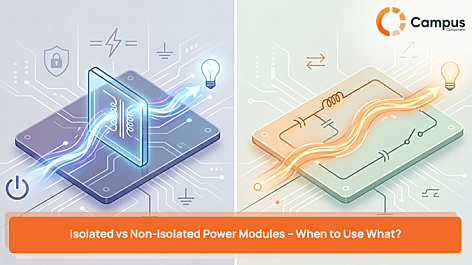
An isolated dc to dc converter power module transfers power between input and output while keeping both sides electrically separated.
This separation is called galvanic isolation, which means there is no direct electrical connection between the two sides of the circuit. Instead, energy is transferred using a transformer or similar isolation technique.
This design helps protect sensitive circuits from:
High-voltage spikes
Ground potential differences
Electrical noise and interference
A simple way to understand it is to think of isolation as a protective barrier. Power can pass through, but electrical disturbances and faults are blocked from spreading across the system.
This is especially important in environments where systems are exposed to fluctuating voltages or multiple grounding points.
What Is a Non-Isolated Power Module?
A non-isolated power module converts voltage without separating input and output electrically. Both sides share a common ground reference.
Because there is no isolation barrier, the design is simpler and more compact. These modules typically use switching regulators like buck or boost converters to achieve voltage conversion efficiently.
They are widely used in systems where:
All components share the same ground
Safety risks are low
Space and cost are critical constraints
In practical terms, non-isolated modules are often chosen when engineers need efficient point-of-load power conversion inside tightly controlled electronic systems.
Key Differences Between Isolated and Non-Isolated Power Modules
Feature | Isolated Power Module | Non-Isolated Power Module |
Electrical Separation | Yes (galvanic isolation) | No |
Safety Level | High | Moderate |
EMI Resistance | Better | Depends on layout |
Efficiency | Slightly lower | Higher |
Cost | Higher | Lower |
Size | Larger | Compact |
Ground Loop Issues | Eliminated | Possible |
Design Complexity | Higher | Lower |
Typical Use Cases | Industrial, medical, telecom | Embedded, consumer electronics |
Advantages of Isolated Power Modules
Enhanced Safety
Isolated modules protect users and sensitive electronics from dangerous voltage levels. This is essential in medical devices, EV systems, and industrial environments.
Better Noise Immunity
Electrical isolation reduces the impact of switching noise and EMI, improving signal stability in complex systems.
Ground Loop Elimination
In large systems, multiple ground points can create unwanted current loops. Isolation prevents this issue and improves system stability.
Easier Compliance with Standards
Many regulated industries require isolation for safety certification. Using isolated modules simplifies compliance with standards such as IEC and UL.
Advantages of Non-Isolated Power Modules
Higher Efficiency
Without a transformer stage, energy loss is lower, making these modules more efficient for low-voltage applications.
Lower Cost
Simpler architecture means fewer components and reduced manufacturing cost.
Compact Design
Non-isolated modules are ideal for space-constrained applications like embedded boards and IoT devices.
Easier Integration
They require fewer supporting components, which reduces design complexity and speeds up development cycles.
When Should You Use an Isolated Power Module?
Isolated modules are the preferred choice when safety and system protection are the key parameters. Therefore they are highly suitable for:
Medical Equipment: Ensures patient safety by preventing electrical leakage.
Industrial Automation: Protects control systems from high-voltage noise and transients.
Telecom Systems: Maintains stability in large distributed networks.
Renewable Energy Systems: Handles high-voltage fluctuations in solar and energy storage systems.
EV Applications: Supports safe power transfer in high-voltage battery environments.
In these cases, isolation is not optional. It is a design requirement.
When Should You Use a Non-Isolated Power Module?
Non-isolated modules are best suited for controlled and low-risk environments. These modules are known for
Embedded Systems: Microcontrollers, sensors, and communication modules.
Consumer Electronics: Smart devices, routers, and home appliances.
Battery-Powered Devices: Where energy efficiency is a priority.
Point-of-Load Regulation: Local voltage conversion near processors or FPGAs.
Here, simplicity, size, and efficiency matter more than electrical isolation.
How to Choose the Right Power Module
Before selecting a module, engineers should evaluate:
Required safety level and regulatory standards
Input and output voltage range
System grounding structure
EMI and noise sensitivity
Power load and efficiency requirements
Physical size constraints
Budget and production scale
Note: If human safety or high-voltage exposure is involved, isolation is usually necessary. Otherwise, non-isolated solutions are often more efficient and cost-effective.
Common Mistakes to Avoid
Many design issues come from incorrect assumptions during selection:
Choosing based only on cost
Ignoring safety and certification needs
Overlooking EMI and grounding challenges
Undersizing power ratings
Using non-isolated modules in noisy industrial environments
Ignoring thermal performance under load
These mistakes often lead to redesigns later in the development cycle.
Future Trends in Power Module Design
Power electronics is evolving quickly with new technologies to boost Industry 4.0, EV platforms, and advanced automation systems. Some of the emerging trends include:
Wide-bandgap semiconductors like GaN and SiC are improving efficiency and reducing size
Higher power density modules are enabling compact system design
Smart power management is adding monitoring and diagnostics features
Integrated protection systems are improving long-term reliability
Endnote
Choosing between isolated and non-isolated power modules is not just a technical preference. It directly impacts safety, performance, system reliability, and long-term cost.
Isolated modules are essential for high-voltage, safety-critical, and industrial applications where protection and noise immunity are priorities. Non-isolated modules work best in compact, low-voltage, and cost-sensitive designs where efficiency and simplicity matter more.
For engineers and OEMs, the key is to evaluate system requirements early instead of treating power selection as a final-stage decision.
Need help choosing between isolated and non-isolated power modules for your design? Connect with our engineering team and explore reliable dc dc converter ic solutions built for real-world industrial applications.
FAQs:
1. What is the main difference between isolated and non-isolated power modules?
Isolated modules separate input and output electrically, while non-isolated modules share a common ground.
2. Why is galvanic isolation important?
It prevents electrical noise, ground loops, and high-voltage faults from affecting sensitive circuits.
3. Are isolated power modules safer?
Yes, they provide better protection in high-voltage and safety-critical applications.
4. Which industries require isolated power modules?
Medical, industrial automation, telecom, EV, and renewable energy sectors commonly require them.
5. Are non-isolated power modules more efficient?
Yes, they are known to offer higher efficiency due to simpler conversion architecture.
6. Can non-isolated modules be used in industrial systems?
Yes, but only in controlled low-voltage sections where isolation is not required.
7. What is a common mistake in selecting power modules?
Choosing based only on cost without considering safety and EMI requirements.
8. How do I decide which one to use?
Evaluate safety needs, voltage levels, EMI conditions, and system architecture before selection