
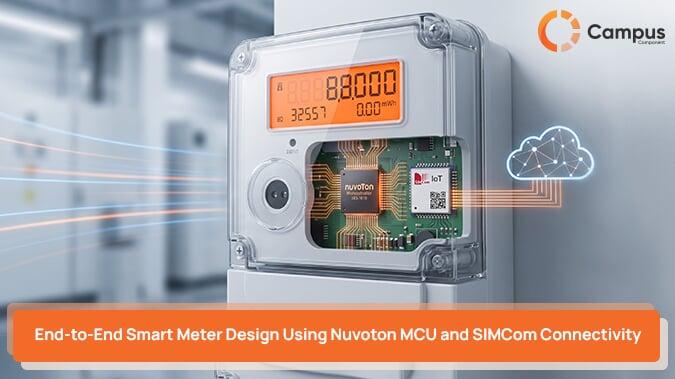
Smart Meter Architecture and Key Design Requirements
Smart Meter Architecture and Key Design Requirements
Smart meters feature a core architecture built around a power system, a microcontroller, and a communication interface that automates two-way data exchange with utility providers.
Voltage and current sensing circuits collect electrical signals from the mains. These measurements are processed by the metering and control electronics to calculate parameters such as energy consumption, voltage, current, and power. The MCU manages calculations, local functions, data storage, timing, and communication.
A simplified data flow looks like this:
Voltage and Current Sensors → Metering Circuit → Nuvoton MCU → SIMCom Module → Cellular Network → Cloud or Utility Server
Depending on the application, the meter also includes local storage, a display, an RTC, tamper monitoring, relay control, and diagnostic functions.
Single-phase meters generally have a simpler sensing and processing architecture. Three-phase smart meters require additional measurement channels and more complex calculations because multiple voltage and current phases must be monitored.
In addition, accuracy and long-term reliability should be considered from the beginning. IEC standards for static electricity meters define requirements and test considerations for areas such as measurement accuracy, repeatability, timekeeping, and electromagnetic influences.
Selecting a Nuvoton MCU for Smart Meter Applications
The MCU acts as the operational hub of the smart meter hardware design. It processes measurement data while managing communication, timing, storage, diagnostics, and other peripheral functions.
Before selecting a Nuvoton MCU, engineers should evaluate:
ADC resolution and available channels
Flash and SRAM requirements
UART, SPI and I²C interfaces
GPIO and PWM availability
RTC and watchdog functionality
Low-power operation
Operating temperature range
Security and firmware protection
The ADC is important because voltage and current measurement require accurate data acquisition. However, the complete measurement accuracy depends on the entire sensing and metering architecture, including signal conditioning, reference stability, calibration, and firmware calculations, not the MCU alone.
Nuvoton's NuMicro portfolio provides options with combinations of ADCs, communication interfaces, RTCs, watchdog timers, and security features. For example, the NuMicro M251/M252 family includes UART-related interfaces, SPI, I²C, watchdog functionality, RTC support and multiple analog peripherals. It also includes memory-protection and code-protection features that can be relevant when protecting embedded firmware.
The best approach is to select the MCU based on the actual meter architecture instead of simply choosing the highest-performance device.
Integrating SIMCom Cellular Connectivity
Cellular communication enables a connected smart meter to send readings beyond the installation site. This is useful for remote monitoring, billing systems, alerts, diagnostics, and firmware management.
A common architecture connects the Nuvoton MCU and SIMCom module through UART. The MCU sends AT commands to configure the module, check network registration, monitor signal conditions, and initiate data communication.
The communication path can be summarized as:
Nuvoton MCU → UART → SIMCom Cellular Module → Mobile Network → Server or Cloud Platform
SIMCom offers cellular modules designed for IoT applications. For example, the A7672X series supports LTE connectivity and provides interfaces including UART, USB, I²C and GPIO, while SIMCom also provides technical resources for UART, TCP/IP, SSL and sleep-mode implementation across relevant module families.
The appropriate technology depends on the deployment. Conventional 4G LTE may suit applications requiring regular data exchange, while LTE-M or NB-IoT may be considered where network availability and lower-data IoT requirements make them suitable.
A reliable design should also account for SIM or eSIM selection, antenna placement, RF layout, and temporary network failures. The meter should not lose readings when connectivity drops. Instead, important data can be stored locally and transmitted once the connection is restored.
Power, Measurement, and Protection Design
The power supply is one of the most important parts of smart energy meter design because the electronics must operate continuously in a mains-connected environment.
The design requires AC-DC conversion followed by regulated low-voltage rails for the MCU, sensing circuits, display, and communication module. The power architecture should be planned around efficiency, isolation requirements, thermal performance, and protection.
The SIMCom module deserves special attention because cellular transmission can create short-duration current demands. If the supply cannot handle these peaks, the module or MCU may experience voltage drops and unexpected resets.
The measurement section should be carefully isolated from noise generated by switching power stages and cellular communication. PCB layout, grounding, filtering, component placement, and EMC planning can directly affect measurement stability.
Depending on the design requirements, protection of smart energy meter includes:
Fuses and overcurrent protection
Surge and transient protection
Isolation barriers where required
Reverse-polarity protection for backup supplies
Thermal monitoring
Battery or backup power can also help preserve the RTC, important system information, or controlled operation during a mains interruption.
End-to-End Data Flow, Security, and Development
A smart meter becomes genuinely useful when its measurement data can be converted into secure, actionable information.
The end-to-end flow includes a chain of actions which include:
Sensors collect electrical data → MCU processes and stores readings → SIMCom module transmits data → Server analyses information → Utility or user receives monitoring data and alerts
The MCU can perform calculations locally before transmission, reducing unnecessary communication and supporting basic edge processing. The backend can then store readings, generate alerts, analyze consumption, and support remote diagnostics.
For interoperability, smart-meter ecosystems use established data-exchange frameworks such as DLMS/COSEM. This framework is designed for standardized data exchange between smart devices and head-end systems and can operate across different communication technologies.
Security should be built into the design rather than added later. Important measures include device authentication, encrypted communication, secure credential storage, firmware protection, error detection, and controlled firmware updates.
Before mass deployment, engineers should test the complete system for network loss, weak signal conditions, power interruptions, temperature variation, communication failures, and recovery behaviour. Long-term component availability also matters because smart meters are expected to remain operational for extended deployment cycles.
Reliable smart meter design requires the right balance of measurement, processing, connectivity, power, and protection. A Nuvoton MCU can handle core processing and control, while SIMCom modules enable remote communication. Campus Component provides these and other essential electronic components to help engineers build dependable, connected smart-meter solutions with fewer design challenges.
Planning a connected smart meter?Explore Nuvoton MCUs, SIMCom modules, power components, and other essential hardware at Campus Component to build a reliable, connected design.
FAQs:
1. What communication protocols can a smart meter use to send data to a utility server?
A smart meter can use cellular IoT connectivity to communicate with a remote server. Depending on the system architecture, protocols such as MQTT or HTTP/HTTPS can be used to transmit meter readings and other device data.
2. What happens if a smart meter temporarily loses cellular connectivity?
The meter can continue collecting readings and store them in internal or external memory. Once the network connection is restored, the stored data can be transmitted to the server, helping minimize data loss during temporary outages.
3. How can a smart meter identify unusual energy consumption?
The MCU can monitor parameters such as voltage, current, power, and energy consumption to identify readings that fall outside predefined conditions. When an unusual pattern is detected, the system can trigger an alert locally or send it to a remote server.
4. Why does a smart meter need a real-time clock (RTC)?
An RTC helps the meter attach accurate timestamps to energy readings and system events. This can be useful for time-based billing, consumption analysis, event logging, and retaining accurate records when network connectivity is temporarily unavailable.
5. What should be tested before deploying a cellular smart meter?
Testing should cover key areas such as measurement accuracy, power-supply stability, cellular connectivity, antenna performance, communication recovery, temperature operation, surge and transient protection, firmware reliability, data security, and long-term system performance.

