
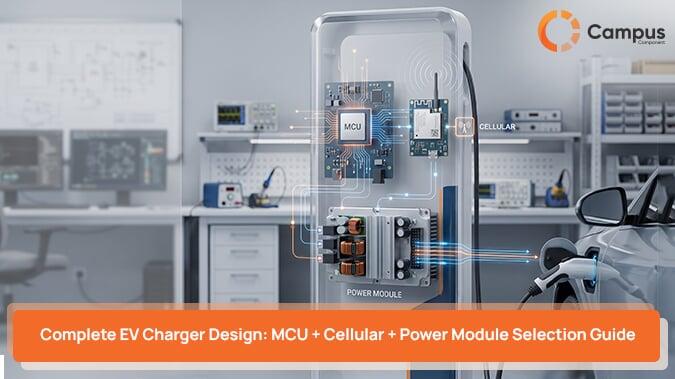
Understanding the Core Architecture of an EV Charger
A modern EV charger typically combines several interconnected blocks:
Power conversion and power distribution
MCU-based control and monitoring
Vehicle and backend communication
Current, voltage, temperature, and energy sensing
Protection circuits and contactors
User interface and charging connectors
In an AC charger, the EVSE primarily manages the safe delivery of AC power and charging control. A DC charger has a more complex architecture because the charger itself performs high-power AC-to-DC conversion before supplying regulated DC power to the vehicle.
The MCU acts as the control centre, while sensors continuously provide information about voltage, current, temperature, insulation, and other operating conditions. The cellular module connects the charger to remote monitoring or management platforms. Meanwhile, AC-DC and DC-DC power modules create the regulated supply rails required by the control electronics.
The first design decisions should always include operating voltage, maximum current, power rating, charging type, installation environment, thermal conditions, and communication requirements.
How to Select the Right MCU for EV Charger Design
The MCU determines how effectively the charger can monitor, control, and respond to changing operating conditions.
For a basic AC charger, the MCU handles pilot signalling, contactor control, energy measurement, display functions, and communication. On the other hand, advanced chargers require additional processing for load management, diagnostics, metering, communication protocols, security, and future software updates.
Engineers should evaluate:
Real-time processing capability
Required GPIO and ADC channels
PWM outputs for control functions
UART, SPI and I²C interfaces
CAN communication where required
Flash and RAM capacity
Firmware security and update capability
Industrial temperature range and long-term availability
ARM Cortex-M-based microcontrollers are widely used because they provide a balance between performance, peripherals, power consumption, and software ecosystem support. Options from manufacturers such as Nuvoton, STMicroelectronics, NXP, and Renesas can be evaluated based on the charger architecture rather than selecting an MCU purely on processing speed.
Development tools and component lifecycle support also matter. An EV charger may remain in production for several years, so replacing an MCU because of poor long-term availability can create unnecessary redesign costs.
Cellular Module Selection for Connected EV Chargers
Cellular connectivity allows charging infrastructure to communicate beyond the installation site. It can support remote status monitoring, fault reporting, diagnostics, billing-related communication, software updates, and backend connectivity.
The right technology depends on the amount and frequency of data being transmitted. Conventional 4G LTE modules may suit applications requiring regular data communication and faster throughput. LTE-M and NB-IoT can be considered for lower-data applications where power consumption, coverage, and network availability match the deployment requirements.
Before selecting a cellular module, consider:
Available network coverage
Supported frequency bands
Required data speed and latency
SIM or eSIM compatibility
UART or USB interfaces
Antenna requirements
GNSS requirements, if applicable
Operating temperature
Peak transmission current requirements
A common design mistake is underestimating the power demand of the cellular module. Cellular transmission can create short-duration current peaks, so the power supply and PCB layout must be designed to handle them without causing voltage drops or system resets.
A suitable antenna and proper RF layout are equally important, particularly for chargers installed in parking basements, industrial areas, or outdoor locations.
Selecting the Right Power Module and Supporting Components
Power design is one of the most critical parts of EV charger development. Even when the main charging stage operates correctly, unstable auxiliary power can affect the MCU, communication module, sensors, and control circuits.
An AC-DC converter is typically used to generate low-voltage power from the mains supply for the control section. DC-DC power modules then create the regulated voltages required by individual circuits.
Engineers should evaluate whether isolated or non-isolated DC-DC modules are appropriate for each section. Isolation might be required where electrical separation, noise reduction, or safety requirements make it necessary. Non-isolated converters can be useful where systems share a common ground and higher efficiency or compact size is preferred.
Key considerations include:
Input and output voltage range
Current capacity
Efficiency
Isolation requirements
Thermal performance
EMI and EMC behaviour
Protection features
Supporting components are equally important. Fuses, TVS diodes, reverse-polarity protection, contactors, relays, connectors, terminal blocks, and appropriate charging connectors should be selected according to the system's electrical and environmental requirements.
A well-designed power tree ensures that each electronic block receives stable power while faults in one section are less likely to disrupt the complete charger.
Complete Component Selection Checklist for EV Charger Development
Before finalizing the design, engineers should review the entire system instead of selecting components independently.
MCU: Does it have sufficient processing power, memory, ADC channels, communication interfaces, and firmware support?
Cellular module: Are the LTE bands, network technology, antenna design, interfaces, and power requirements suitable for the deployment region?
Power modules: Can the AC-DC and DC-DC stages provide stable voltage and current under full load and temperature variations?
Communication components: Are CAN, UART, Ethernet, Wi-Fi, or other interfaces required for the charger architecture?
Sensors: Can the system accurately monitor current, voltage, temperature, energy, and fault conditions?
Protection: Have appropriate fuses, surge protection, isolation, and fault-handling mechanisms been included?
PCB and thermal design: Does the layout minimize noise, support heat dissipation, and separate sensitive control circuits from high-power sections where required?
Lifecycle and production: Are the selected components available for long-term production, and can they support future firmware or feature upgrades?
The best EV charger design balances performance, reliability, compliance requirements, component availability, and BOM cost. The cheapest component is not always the most cost-effective choice if it creates redesign, maintenance, or supply-chain challenges later.
The Bottom Line
A complete EV charger is a carefully coordinated system where power conversion, intelligent control, sensing, protection, and connectivity must work together. Selecting the MCU, cellular module, and power modules early in the design process helps engineers build a stronger and more scalable architecture.
Campus Component supports EV product development with a range of microcontrollers, cellular and wireless modules, AC-DC and DC-DC power solutions, protection components, antennas, connectors, and other electronic components required for connected charging systems.
Planning your next EV charger design? Explore Campus Component’s range of electronic components and get the right support for selecting MCUs, cellular modules, power solutions, and supporting hardware that match your charger’s technical and deployment requirements. Build a charging system that is ready not only for testing, but for reliable real-world operation.
FAQs
1. What communication protocols are commonly used in EV charger systems?
EV chargers can use different communication protocols, including CAN, UART, Ethernet, Wi-Fi, and cellular networks, depending on how the charging system is designed. These protocols allow the various components of the charger to communicate with each other and support essential functions such as real-time monitoring, fault diagnosis, remote control, and communication with backend systems.
2. How can engineers reduce EMI and EMC issues in EV charger designs?
Engineers can minimize EMI and EMC issues by paying close attention to PCB layout, grounding, shielding, filtering, component placement, and cable routing. Keeping high-power switching circuits separate from sensitive control and communication components can further limit electrical noise and help the system operate more reliably.
3. What factors should be considered when selecting an EV charging connector?
The connector should match the charging type, voltage and current ratings, applicable standards, mechanical and environmental conditions, and installation needs. It must also be compatible with the target vehicle and charging application.
4. How does thermal management affect EV charger component selection?
Effective thermal management plays a key role in the reliability and lifespan of EV charger components. When choosing components, engineers should account for power losses, ambient temperature, heat dissipation, airflow, thermal limits, and whether heat sinks or other cooling methods are needed.
5. What testing and validation should be completed before deploying an EV charger?
Testing should cover everything from electrical performance and protection features to thermal behaviour, communication, safety, fault handling, and performance under different environmental conditions. Before moving from development to production, engineers should also confirm that the system meets all relevant regulatory and charging standards.

