
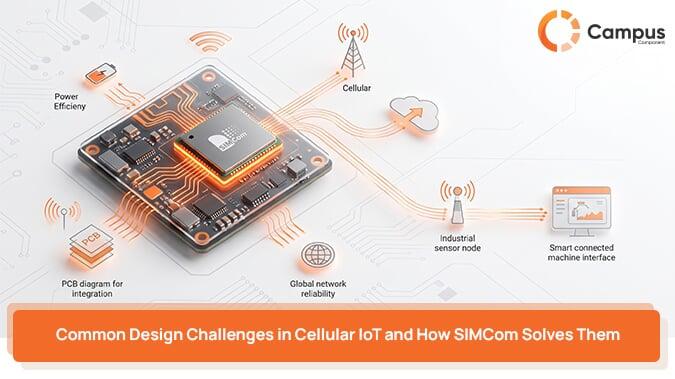
Understanding the Major Challenges in Cellular IoT Design
A successful cellular IoT design needs to balance three things, which include, reliable connectivity, efficient operation, and practical system cost.
The challenge starts with selecting the appropriate cellular technology. Depending on the application, engineers might evaluate 4G LTE, LTE-M, NB-IoT, or other supported technologies. The decision depends on factors such as data requirements, coverage, mobility, power budget, deployment region, and expected device lifetime.
Network compatibility is another key consideration. A module designed for one market does not automatically suit every other region. Supported frequency bands, network technologies, certifications, SIM or eSIM requirements, and local operator compatibility need to be checked before finalising the hardware.
Challenge 1: Connectivity, Coverage and Antenna Design
Reliable cellular IoT connectivity depends on more than the cellular module itself. Poor antenna placement, unsuitable frequency-band support, PCB interference, or nearby metal components can reduce signal quality and affect communication reliability.
Engineers should evaluate:
Supported LTE or cellular frequency bands
Network coverage in the deployment area
Antenna type and placement
PCB layout and ground-plane requirements
RF routing and antenna clearance
SIM or eSIM configuration
Network registration and reconnection behaviour
Signal-strength monitoring
This becomes important for devices installed in remote or difficult-to-access locations. A connected industrial controller or smart meter needs to recover from temporary network interruptions without requiring physical intervention.
SIMCom offers different SIMCom cellular modules and IoT connectivity solutions that can be evaluated according to network, application, and regional requirements. Selecting the appropriate module early allows the RF, antenna, PCB, and firmware design to be developed around the actual connectivity requirements.
Challenge 2: Managing Power Consumption and Battery Life
Cellular communication can create significant power demands, particularly during network transmission. Short current spikes during communication also mean that the power supply needs to be designed with the module's operating requirements in mind.
For battery-powered products, engineers need to look beyond average power consumption. The design should account for transmission frequency, network conditions, sleep periods, peak current requirements, and the application's expected battery life.
A practical cellular IoT power consumption strategy can include:
Selecting a module suited to the application's power budget
Using supported sleep or power-saving modes
Managing communication intervals
Processing data locally before transmission
Selecting an appropriate power supply and battery
Optimizing hardware and firmware together
Where supported by the selected cellular technology and module, features such as PSM and eDRX can help reduce power consumption during periods of low activity.
For battery-operated sensors, trackers, and remote monitoring equipment, these decisions should be made during the initial architecture stage rather than after the hardware has been designed.
Challenge 3: Integrating the Cellular Module with the MCU
A cellular module typically works alongside an MCU that manages the application's sensing, control, processing, and data-handling functions. This creates another important part of cellular IoT hardware integration.
The MCU and module need a suitable communication interface, commonly UART or USB, depending on the selected devices and architecture. Engineers also need to develop firmware for tasks such as:
Sending and processing AT commands
Network registration
Establishing and managing data sessions
Handling communication errors
Detecting module resets
Managing reconnection
Transmitting application data
Using SMS, GNSS, voice, or other supported functions
Development boards and evaluation kits can make this process easier during the prototyping stage. They allow engineers to test module behaviour, interfaces, network connectivity, and firmware commands before committing to a custom PCB.
A suitable SIMCom IoT module can therefore reduce integration effort by providing the connectivity functions required by the target application while allowing the main MCU to focus on application-level processing.
Challenge 4: Security, Reliability and Network Recovery
A connected device needs to remain reliable even when network conditions are not ideal. Temporary network outages, weak signals, module resets, or communication failures can interrupt data transmission.
Firmware should therefore include appropriate mechanisms for detecting connectivity problems, retrying network registration, managing failed data sessions, and storing important information locally when required.
Security also needs to be considered throughout the design. Depending on the application, engineers should evaluate secure communication protocols, device authentication, data protection, firmware security, and OTA update requirements.
For large IoT deployments, remote monitoring becomes equally important. A connected device should provide enough status information for teams to identify communication failures, abnormal behaviour, or hardware issues without physically accessing every deployed unit.
Challenge 5: Scaling from Prototype to Production
A module that works successfully on a development board still needs to meet the requirements of the final product.
Before moving from prototype to production, engineers should verify:
Network and regional compatibility
RF and antenna performance
Power-supply stability
Operating temperature requirements
Certification and regulatory requirements
Firmware reliability
Module availability and lifecycle status
Long-term sourcing requirements
Production and testing requirements
This is especially important for products expected to remain in the field for several years. Changing the cellular module after deployment can involve PCB redesign, firmware changes, certification work, and additional testing.
For this reason, cellular IoT module selection should consider both current technical requirements and the product's expected lifecycle.
How SIMCom Supports Different Cellular IoT Requirements
The portfolio of SIMCom includes cellular, GNSS, and wireless solutions that can be evaluated for different IoT connectivity requirements. Depending on the application, engineers can select modules based on cellular technology, frequency bands, interfaces, power requirements, GNSS functionality, and other technical specifications.
Campus Component provides SIMCom modules and development-related electronic components for engineers and product developers working on connected products. Its broader portfolio includes Nuvoton microcontrollers, development boards, power-management components, connectors, circuit-protection devices, and other components used in embedded and IoT designs.
This can help engineers approach connectivity as part of the complete system rather than treating the cellular module as an isolated component.
Choosing the Right SIMCom Module for Your IoT Design
There is no single best cellular module for every IoT application. The right choice depends on where the product will operate, how much data it needs to transmit, how frequently it communicates, its power budget, and the required interfaces and features.
Before selecting a SIMCom LTE module, SIMCom LTE-M module, or other cellular solution, engineers should define the application's connectivity, power, RF, processing, security, environmental, certification, and lifecycle requirements.
A careful selection process at the beginning can prevent expensive redesigns later and create a clearer path from prototype development to mass production.
The Bottom Line
Cellular IoT design involves several connected engineering decisions. Network compatibility, antenna performance, power consumption, MCU integration, security, firmware reliability, and long-term component availability all influence the success of the final product.
SIMCom provides cellular and wireless module options that can be evaluated against these requirements, while Campus Component can support engineers in identifying suitable SIMCom modules and related electronic components for their projects.
Building a cellular IoT product? Explore SIMCom modules and related components through Campus Component to find connectivity solutions that match your application's technical and deployment requirements.
FAQs:
1. How does antenna placement affect cellular IoT performance?
Antenna placement directly affects signal strength, connectivity, and overall device reliability. When designing a cellular IoT device, engineers should consider the enclosure, PCB layout, ground plane, nearby metal parts, antenna clearance, and the operating frequency bands.
2. Can a single cellular IoT module work across multiple regions?
Yes, if the module supports the required frequency bands, network technologies, and certifications for those regions. Before selecting a module for a multi-country product, engineers should verify network compatibility and regulatory requirements in each target market.
3. What happens to an IoT device when the cellular network goes down?
A well-designed IoT device can detect the network failure, continue collecting important data, and store it locally until connectivity returns. Firmware can then manage reconnection and transmit the stored data, helping maintain data continuity during temporary outages.
4. How can engineers reduce cellular data usage in IoT devices?
Engineers can reduce data usage by sending information at suitable intervals instead of continuously, transmitting only important changes or events, and processing data locally before transmission. Data compression can also help reduce the amount of information sent over the cellular network when needed.
5. What should engineers check before choosing a SIMCom module for an IoT product?
Engineers should evaluate the network technology, supported frequency bands, interfaces, power requirements, data rates, GNSS capability, operating temperature, antenna requirements, certifications, software support, availability, and lifecycle status of the module. These factors help ensure that the selected SIMCom module fits both the technical and deployment requirements of the IoT product.

