
 What is a BLDC Motor?
A brushless DC motor is a small but powerful type of electric motor that uses direct current as its power source. The motor is named so because they use electronic commutation instead of mechanical brushes. Unlike traditional DC motors, BLDC motors rely on external controllers to switch current in the motor windings at the right time. It has gained high-popularity because of their size and efficiency.
Some of its key features which make BLDC motors offer high efficiency, strong torque output, and lower heat generation compared to traditional motors, include:
Construction: The rotor is made of permanent magnets, while the stator contains coil windings.
No Brushes/Commutator: BLDC motors do not use brushes or a mechanical commutator, which reduces friction and wear.
Works with electronic commutation: An electronic controller manages commutation by switching current in the stator windings. This is often supported by Hall effect sensors for accurate rotor position detection.
Performance: This electronic switching creates a rotating magnetic field that drives the rotor smoothly.
Key benefits of these motors include:
Higher-efficiency
Longer lifespan
Less maintenance
What is Hall Sensor-Based Control?
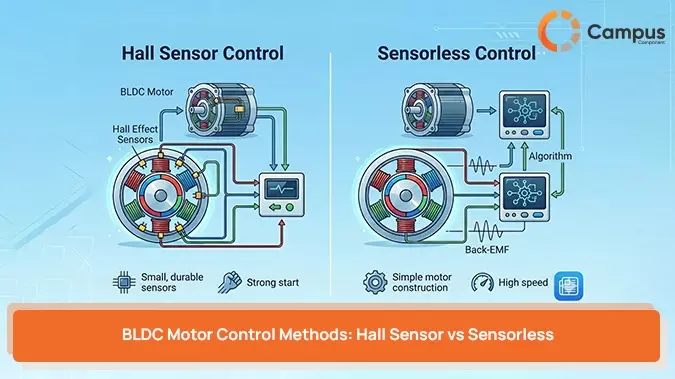
Hall-sensor based control refers to a motor management system that mainly uses hall-Effect sensors to detect the precise position of a brushless DC motor rotor to enable efficient electrical commutation. These sensors act as feedback, allowing the motor controller to switch stator winding currents at the current moment, replacing the mechanical brushes used in conventional motors. They generate digital signals as the rotor magnets pass by them. The controller uses these signals to decide when to energize each motor winding, thereby ensuring proper rotation.
Components involved:
Hall sensors
Permanent magnet rotors
Stator windings
Motor or Electronic speed controller
Power MOSFETs or inverter
Microcontroller or DSP
What is Sensorless Control in BLDC Motors?
Sensorless control in BLDC motors is a technique that manages motor commutation and speed by eliminating the rotor’s position by using the motor’s back electromotive force instead of physical sensors like Hall-effect sensors.
At this stage, the controller continuously monitors the voltage in the un-energized phase and detects the zero-crossing point, which mainly occurs when the back EMF crosses half of the DC bus voltage. This zero-crossing event is then used to estimate the rotor position and determine the right timing for commutation, allowing the controller to energize the next set of windings and maintain smooth, continuous rotation.
Key Differences: Hall Sensor vs Sensorless Control
The below table represents the major differences between hall sensor and sensorless control:
Feature | Hall Sensor (Sensored) | Sensorless Control |
Position Detection | Uses magnetic sensors (Hall Effect) to detect position directly. | Uses back-EMF (electromotive force) of the motor windings to estimate position. |
Low-Speed Torque | High because it is excellent for starting under load. | Low. This is why the motors struggle at low speeds. |
Start-Up Performance | Smooth and precise. | Can be erratic until back-EMF is generated. |
Reliability/Durability | Lower, as sensors can fail in harsh conditions. | Higher as there are no sensors to fail. |
Complexity | Simple electronics, but more wiring or maintenance. | Complex algorithms, but less wiring. |
Cost | Generally higher due to component costs. | Generally lower. |
Best Application | Robotics, EV, high torque or low speed. | Fans, pumps, high-speed applications. |
Advantages of Hall Sensor-Based Control
Hall sensor-based systems are preferred when precision at low speed and reliability are essential. Some of their key advantages include:
They offer reliable starting torque even at low speed.
These systems are known for offering stable low-speed operation.
They mostly provide simple control logic for engineers.
These sensors are widely used in EVs and robotics
Advantages of Sensorless Control
On the other hand, these particular systems have their own sets of advantages. They are ideal for the scenarios where cost and simplicity matter more than low-speed precision, like computer cooling fans, home appliances such as vacuum cleaners and refrigerator compressors. Some of its key advantages include:
Lower system cost
More compact motor design
Higher efficiency at medium to high-speeds
Reduced wiring and hardware complexity
Limitations of Each Method
Though these motors are widely used across a wide array of applications, but they possess certain limitations, which include:
In case of hall sensor-based control:
Increased costs due to additional hardware
Failure of sensors in harsh environments such as dust, vibration, or heat
Slight reduction in long-term reliability
In case of sensorless control:
Poor performance at very low or zero speed
Intricate algorithms required for accurate detection
Not ideal for high starting torque applications
Use Cases and Applications
Here are some key applications of hall sensor-based BLDC motors:
Electric vehicles
Robotic arms and precision control systems
Industrial automation machines
HVAC systems which require stable low-speed control
Some key applications of BLDC motors:
Cooling fans and blowers
Drone and UAVs
High-speed pumps
Consumer electronics and appliances
Which One Should You Choose?
Choosing between Hall sensor and sensorless control completely depends on the purpose you want to use these motors. With the growing EV and automation sector in India, both approaches are widely used depending on performance and budget performance. So, here are the following points that help you choose the right system:
If you need strong startup torque and precise low-speed control, go for Hall sensor-based BLDC motors.
If your application prioritizes cost efficiency and high-speed operation, sensorless control is a better choice.
On the other hand, for hybrid industrial systems, advanced controllers combine both methods for optimal performance.
Future Trends in BLDC Motor Control
BLDC motor technology is evolving rapidly with advanced control strategies. These innovations are expected to make BLDC systems smarter, more efficient, and more adaptable for industrial use. Some of the key futuristic trends include:
FOC (Field-Oriented Control): Provides smoother torque and higher efficiency compared to traditional trapezoidal control
AI-based motor control: Adaptive systems that optimize performance in real-time
Hybrid sensing systems: Combining sensor and sensorless methods for better accuracy
Advanced back EMF algorithms: Improving low-speed sensorless performance
The Bottom Line
In real-world applications, the choice between Hall sensor-based and sensorless BLDC control comes down to how the motor is expected to perform. Systems that require smooth startup and precise low-speed control benefit from Hall sensors, while high-speed, cost-sensitive applications are better suited for sensorless designs. Understanding these differences helps in building efficient, reliable, and application-focused motor control systems.
Ready to choose the right BLDC control for your application? Connect with our experts for tailored guidance and reliable sensor solutions that ensure precision, efficiency, and long-term performance.
FAQs:
1. What is the main difference between Hall sensor and sensorless BLDC control?
Hall sensor control uses physical sensors for rotor position, while sensorless control uses back EMF to estimate position.
2. Is sensorless BLDC control better?
It depends on the application. It is better for high-speed, cost-sensitive systems but not ideal for low-speed torque applications.
3. Why are Hall sensors used in BLDC motors?
They provide accurate rotor position feedback, especially useful during startup and low-speed operation.
4. What is back EMF in BLDC motors?
Back EMF is the voltage generated in motor windings when the rotor spins, used in sensorless control to estimate position.
5. Which BLDC control method is used in electric vehicles?
Most EVs use Hall sensors or hybrid systems because they need strong starting torque and precise control.
6. Can sensorless BLDC motors start on their own?
They struggle at zero speed and often require special startup algorithms or open-loop control.
7. What is the future of BLDC motor control?
The future is moving toward FOC, AI-based adaptive control, and hybrid sensing systems for better efficiency and precision.