
 What Are AC-DC Power Modules?
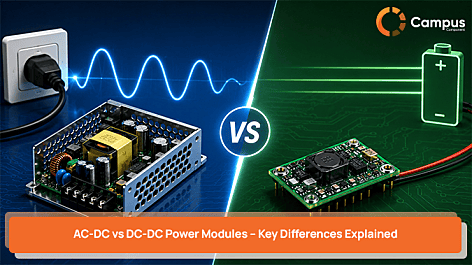
An AC-DC power module converts alternating current (AC) from the mains supply into a stable direct current (DC) output suitable for electronic circuits. AC input voltage, like 110V/230V is first rectified, filtered, and then regulated to produce a stable DC output. Modern modules often use switching technology for higher efficiency and compact design.
Some common applications
Today, most digital microcontrollers, sensors, and displays operate on DC power. Here are some applications of these power modules:
Industrial automation systems, which include powering factory PLCs, sensors, and control panels.
Consumer electronics power supplies for smart home devices, routers, and appliances.
AC-DC power modules are widely used in embedded control systems, small cell base stations, access devices, and other space-constrained scenarios.
These modules are widely used in telecommunication and IoT devices, where compact designs allow them to fit inside tightly spaced enclosures.
Benefits
Direct conversion from mains supply: Converts standard AC mains electricity directly into usable DC power for electronic systems.
Stable regulated DC output: Delivers a consistent output voltage to help electronic components operate safely and reliably.
Wide input voltage range options: Supports different input voltage conditions, making it suitable for varied regional and industrial power environments.
High reliability in industrial environments: Built to perform consistently in demanding applications where durability and continuous operation are essential.
Limitations
Higher heat generation in compact designs: Smaller designs can produce more heat, making thermal management an important design consideration.
Requires safety isolation and protection circuits: Needs built-in protection and electrical isolation to ensure safe operation, especially in mains-powered applications.
Typically larger compared to DC-DC modules: Usually requires more space due to its power conversion architecture and safety components.
What Are DC-DC Power Modules?
A DC-DC power module converts one DC voltage level to another DC voltage level, ensuring precise voltage regulation for electronic components. It uses high-frequency switching circuits along with inductors and capacitors to step up (boost), step down (buck), or isolate voltage levels efficiently.
Types of DC-DC Converters
Buck Converter (Step-down)
Boost Converter (Step-up)
Buck-Boost Converter
Isolated DC-DC Converter
Benefits
High conversion efficiency: Delivers more usable power while helping reduce overall energy loss.
Compact PCB-friendly design: Fits easily into space-constrained designs without complicating thepcb terminal block
Low heat dissipation: Generates less heat, helping improve system performance and reliability.
Ideal for battery-powered systems: Well suited for battery-operated devices where power efficiency matters most.
Limitations
Requires stable DC input source: Works best only when the input power is steady and well-regulated.
EMI/Noise considerations in sensitive circuits: These power modules can produce electrical noise that needs careful handling in sensitive designs.
Limited power range depending on design: Can only handle a specific power range, depending on how the system is built.
AC-DC vs DC-DC Power Modules – Major Differences
The below points describe the key differences between the two major types of modules which include:
Input source: AC-DC modules take power directly from the AC mains supply, while DC-DC modules operate using an existing DC input source like a battery or regulated DC rail.
Output characteristics: AC-DC modules deliver a stable DC output after conversion, whereas DC-DC modules adjust and regulate DC voltage levels up or down based on circuit requirements.
Conversion process: AC-DC involves rectifying and regulating alternating current into DC, while DC-DC uses high-frequency switching techniques to modify DC voltage efficiently.
Efficiency: Moreover,DC-DC modules are generally more efficient for localized voltage regulation, while AC-DC efficiency depends on conversion stage and load conditions.
Size and thermal performance: DC-DC modules are typically more compact with lower heat generation, whereas AC-DC modules are larger and may require more thermal management due to mains conversion.
Isolation and safety: AC-DC modules usually include stronger isolation from high-voltage mains for safety, while DC-DC isolation depends on whether the design is isolated or non-isolated.
Cost comparison: AC-DC modules often cost more due to safety components and higher power handling, while DC-DC modules are generally more cost-effective for internal system voltage regulation.
Comparison Table: AC-DC vs DC-DC Power Modules
With the help of the below table, you could easily get a clear overview of key features about two power modules:
Feature | AC-DC Power Module | DC-DC Power Module |
Input Type | AC mains (110V/230V) | DC input source |
Output | Regulated DC | Regulated DC |
Conversion | AC to DC | DC to DC |
Efficiency | Moderate to High | High |
Size | Larger | Compact |
Isolation | High (mains safety) | Optional (based on design) |
Heat Dissipation | Higher | Lower |
Typical Use | Power supplies, industrial systems | Embedded systems, IoT, automotive |
Applications of DC-DC Power Modules
Though these power modules possess a wide array of applications across various fields, some of the major ones include:
Automotive Electronics
Used in infotainment systems, ECUs, and battery management systems where multiple voltage levels are required.
Embedded Systems
Microcontrollers, sensors, and FPGA-based systems rely on DC-DC modules for stable voltage regulation.
IoT Devices
Battery-powered IoT devices use efficient DC-DC conversion to extend operational life.
Renewable Energy Systems
Solar and energy storage systems use DC-DC converters for voltage optimization and energy management.
How to Choose the Right Power Module
When selecting between AC-DC and DC-DC modules, engineers should evaluate:
Input Source Availability: AC mains or DC battery or any other source
Efficiency Requirements: Critical for battery or thermal-sensitive designs
Isolation Needs: Safety requirements for industrial or high-voltage systems
Space Constraints: PCB footprint limitations
Thermal Performance: Heat dissipation capability of the system
A well-balanced selection improves system stability and long-term reliability.
Common Challenges in Power Module Selection
Though there are a wide range of advantages of power modules, they possess some challenges which include:
Heat Management: Poor thermal design can reduce efficiency and lifespan
EMI Issues: Switching noise can affect sensitive analog circuits
Voltage Instability: Poor regulation impacts system reliability
Component Reliability: Industrial environments demand rugged designs
Future Trends in Power Conversion Technology
Power modules are evolving rapidly with increasing demand for compact, efficient systems:
Smart power modules with integrated monitoring
High-efficiency GaN and SiC-based converters
Miniaturized PCB-integrated power solutions
Increased demand from EV and renewable energy sectors
Intelligent power management systems with adaptive control
Conclusion
AC-DC and DC-DC power modules serve different but equally critical roles in modern electronics. AC-DC modules are essential for converting mains power into usable DC supply, while DC-DC modules ensure precise voltage regulation within systems.
For engineers and designers, selecting the right module directly impacts efficiency, thermal performance, and system reliability. Platforms like Campus Component provide a wide range of reliable AC-DC and DC-DC power modules designed for industrial, embedded, and automation applications, ensuring performance-driven power solutions for modern engineering needs.
Upgrade your power design with reliable AC-DC and DC-DC modules. Connect with our team today.
FAQs:
1. What is the main difference between AC-DC and DC-DC modules?
AC-DC converts alternating current to direct current, while DC-DC converts one DC voltage level to another.
2. Which is more efficient: AC-DC or DC-DC?
DC-DC converters are generally more efficient due to localized voltage regulation and reduced power loss.
3. Where are DC-DC converters commonly used?
They are widely used in embedded systems, automotive electronics, IoT devices, and renewable energy systems.
4. Can AC-DC modules be used in embedded systems?
Yes, AC-DC modules provide primary power conversion, while DC-DC modules handle internal voltage regulation.
5. What factors should I consider when selecting a power module?
Input source, efficiency, thermal constraints, isolation requirements, and space limitations are key factors.