
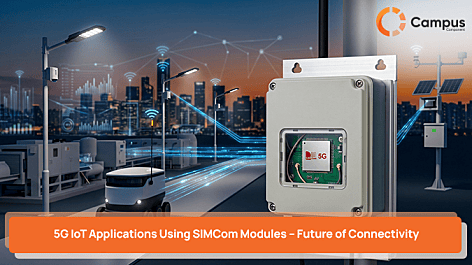
Understanding 5G Technology in IoT Ecosystems
Many people have a conception that 5G is a faster version of 4G. It changes how IoT systems behave under load, scale, and latency constraints, while considering its design part. 5G introduces three major transitions to the connectivity era:
Very low latency, often close to real-time response
Massive device density, supporting large-scale IoT deployments
Higher reliability, especially for mission-critical applications
This combination allows IoT systems to move from periodic data reporting to continuous, real-time decision-making. For example, instead of sending sensor data every few seconds, devices can now support instant updates for control systems, safety monitoring, or automation loops.
In real terms, this technology is the key source that enables autonomous systems, smart factories, and connected infrastructure to function reliably at scale.
What Are SIMCom 5G Modules?
simcom modem 5G modules are compact wireless communication units designed to provide cellular connectivity for IoT and embedded systems. They combine 5G modem capabilities with multiple network standards, making them suitable for global deployments.
Unlike traditional communication components that only provide basic data transmission, modern SIMCom IoT modules are designed to support advanced applications requiring faster response times, higher bandwidth, and consistent network performance.
One such advanced solution is the SIMCom SIM8262E-M2 5G module, designed for high-performance IoT and industrial connectivity applications. It supports 5G communication capabilities with multi-mode network compatibility, making it suitable for applications that require reliable cellular connectivity, high-speed data transfer, and future-ready network performance.
Key capabilities of SIMCom 5G modules, including solutions like SIM8262E-M2, include:
5G NR (New Radio) support
LTE fallback for coverage continuity
High-speed data transmission capability
GNSS integration in some variants
Multi-band cellular connectivity
Industrial-grade reliability for harsh environments
What makes them important in real-world systems is their stability under different network conditions. In many IoT deployments, especially in industrial environments, consistent connectivity mainly matters more than the peak speed.
Why is 5G Transforming IoT Connectivity?
The impact of 5G on IoT is less about speed alone and more about system behavior. Here are some key reasons which makes this technology is meant to be the core pillar in today’s connectivity:
Faster communication
Devices can now transmit large datasets almost instantly. This is highly essential for applications like video-based monitoring, machine vision, and autonomous control systems.
Real-time processing
5G reduces communication delays significantly, enabling systems to respond in near real time. In industrial automation, even milliseconds can matter.
Massive device support
These SIMCom modules can help many factories, cities, and transport systems connect thousands of devices in a single network without performance breakdown.
Improved network efficiency
Unlike older networks that struggle under heavy device loads, 5G is designed to manage traffic more intelligently across edge and cloud layers.
Top 5G IoT Applications Using SIMCom Modules
The selection of the right communication module plays a crucial role in determining the performance and scalability of an IoT system. SIMCom modules such as the SIM8262E-M2 enable developers to build advanced connected solutions where high-speed data transfer, reliable connectivity, and real-time communication are essential.
With its 5G capabilities, the module can support applications that require continuous data exchange between devices, cloud platforms, and edge computing systems. This makes it suitable for next-generation applications such as:
Smart Manufacturing and Industry 4.0
In manufacturing environments, SIMCom 5G modules enable real-time machine monitoring, predictive maintenance, and robotics coordination. Factories can track production lines continuously and respond instantly to system changes. This reduces downtime and improves production efficiency without manual intervention.
Smart Cities and Infrastructure Management
Smart city systems rely heavily on distributed sensors and communication nodes. With 5G connectivity, SIMCom modules support traffic monitoring, smart lighting, waste management, and public safety systems. Data from thousands of devices can be processed in real time to improve urban operations.
Autonomous Vehicles and Transportation
Connected mobility systems depend on instant communication between vehicles, infrastructure, and cloud platforms. SIMCom 5G modules enable low-latency communication required for:
Vehicle-to-vehicle updates
Traffic prediction systems
Fleet tracking and telematics
This is a key foundation for autonomous driving systems.
Smart Agriculture Solutions
Modern agriculture is increasingly data-driven. Sensors in soil, weather stations, and irrigation systems rely on continuous connectivity. 5G-enabled modules help farmers:
Monitor crop conditions remotely
Automate irrigation systems
Improve yield prediction accuracy
This reduces resource waste and improves productivity.
Energy and Utility Monitoring
Power grids, solar farms, and water systems require constant monitoring. SIMCom modules help transmit real-time data from remote installations to central systems.
Retail and Smart Vending Systems
In retail environments, smart vending machines and connected kiosks use 5G for inventory tracking, transaction processing, and remote diagnostics. This ensures better uptime and reduced maintenance costs.
Key Benefits of SIMCom 5G Modules for Enterprises
For businesses, the value of SIMCom 5G modules is not just technical connectivity. It is operational reliability.
Reliability: Stable connectivity in variable network environments
Security: Enhanced data protection for IoT communication
Scalability: Supports large-scale device deployment
Global connectivity: Works across regions with multi-band support
These benefits directly support enterprise IoT adoption at scale. This allows utilities to detect faults early and optimize energy distribution.
SIMCom 5G Modules vs Traditional IoT Communication Technologies
Technology | Latency | Scalability | Use Case Fit |
5G (SIMCom) | Very Low | Very High | Real-time IoT, automation |
4G LTE | Medium | High | General IoT systems |
Wi-Fi | Low (local) | Limited | Indoor systems |
LPWAN | High latency | Very High | Low-data sensors |
Deployment Considerations and Best Practices
Selecting a 5G module for an IoT project requires careful evaluation of application requirements, network conditions, and future scalability. Modules like SIMCom SIM8262E-M2 help simplify this process by providing a high-performance communication foundation for developers building advanced IoT products. Before deployment, engineers should consider:
Compatibility with existing hardware platforms
Required data speed and network coverage
Antenna design and RF performance
Power consumption requirements
Cloud communication protocols
Long-term product scalability
For OEMs and system integrators, choosing a reliable module early in the design phase can reduce development intricacy and improve overall product reliability.
Future Trends in 5G IoT Connectivity
Nowadays, many industries are widely adoptingwifi module for iot devices for matchless connectivity and to boost real-time applications. Following are some futuristic trends that going to transform the way industries operate:
AI-driven IoT
IoT systems will increasingly use AI to process data at the edge before sending it to the cloud.
Edge computing
More decision-making will happen closer to devices, reducing dependency on centralized systems.
Private 5G networks
Enterprises will deploy dedicated 5G infrastructure for secure and controlled environments.
Digital twins
Physical systems will be mirrored digitally for simulation, monitoring, and prediction.
Smart infrastructure
Cities and industries will operate as interconnected digital ecosystems.
Why Businesses Choose SIMCom for 5G IoT Projects
SIMCom has become a trusted name in cellular IoT connectivity by providing communication modules designed for industrial, commercial, and embedded applications. Its solutions focus on balancing performance, reliability, and ease of integration, which are critical factors for large-scale IoT deployments.
Among its advanced solutions, the SIMCom SIM8262E-M2 5G module provides developers with a powerful platform for building future-ready IoT applications. Its high-speed connectivity capabilities and flexible integration options make it suitable for industries moving toward smarter and more connected ecosystems.
Key advantages include:
High-speed 5G connectivity for data-intensive applications
Reliable communication for industrial and commercial deployments
Support for next-generation IoT architectures
Suitable integration capabilities for embedded designs
Designed for applications requiring scalable connectivity solutions
For businesses investing in long-term IoT infrastructure, selecting a proven communication module helps reduce development risks while ensuring compatibility with evolving connectivity requirements.
Final Thoughts
5G has emerged as a key technology that not only improves IoT connectivity but also changes the structure of how connected systems are designed and operated. With SIMCom 5G modules, businesses can move from basic connectivity to real-time intelligent systems that scale across industries.
From smart manufacturing to connected mobility and smart cities, the combination of 5G and SIMCom modules is shaping the next phase of IoT evolution. For enterprises planning future-ready systems, this is no longer an emerging technology. It is becoming the baseline.
Ready to build next-generation IoT solutions with SIMCom 5G modules? Connect with our experts to explore the right connectivity solution for your industrial, automotive, healthcare, or smart city application.
FAQs:
1. What are SIMCom 5G modules?
SIMCom 5G modules are communication modules that help devices connect to 5G networks. They enable fast, reliable, and real-time data exchange for a wide range of IoT applications.
2. How does 5G improve IoT connectivity?
5G makes IoT systems faster and more responsive by reducing communication delays and supporting a larger number of connected devices at the same time.
3. Which industries can benefit from SIMCom 5G modules?
Industries such as manufacturing, transportation, healthcare, agriculture, energy, and smart cities can use SIMCom 5G modules to improve connectivity, monitoring, and operational efficiency.
4. Can SIMCom 5G modules be used in industrial automation?
Yes. SIMCom 5G modules are well suited for industrial automation applications, helping businesses enable real-time machine monitoring, predictive maintenance, and smart factory operations.
5. How do SIMCom 5G modules support edge computing?
They allow data to be transferred quickly between devices and processing systems, helping businesses make faster decisions and reduce reliance on centralized cloud processing.
6. What should businesses consider before deploying 5G IoT solutions?
Businesses should evaluate factors such as network availability, security requirements, system compatibility, and future scalability to ensure a successful deployment.
7. What is SIMCom SIM8262E-M2 used for?
SIMCom SIM8262E-M2 is a 5G communication module designed for high-speed IoT and embedded applications. It can be used in industrial automation, smart gateways, connected devices, remote monitoring systems, and other applications requiring reliable cellular connectivity.
8. Why are SIMCom 5G modules a good choice for future IoT projects?
SIMCom 5G modules are designed to support next-generation connectivity requirements, making them ideal for applications that demand speed, reliability, and long-term scalability.